Through Australia’s Indigenous Rangers Program, First Nations people are managing land, river and sea Country, in line with Traditional Owners’ objectives, using traditional knowledge and cultural practices combined with Western science.
Over 190 ranger groups work across some of the country’s most remote locations to enhance biodiversity, control pests, and protect cultural sites. Aboriginal and Torres Strait Islander teams are the front-line in protecting Northern Australia’s vast 10,000 kilometre, sparsely populated coastline from high-risk pests and diseases, which can reach Australia via wind, tide and animal migration, and through travel and trade with Papua New Guinea, just a few kilometres from the northernmost Torres Strait Islands.
When Sydney-based realtime and virtual production studio, Mod was approached, the team was keen to support this fantastic work!
Australia’s Department of Agriculture, Fisheries and Forestry (DAFF), which manages the Northern Australia Indigenous Ranger Biosecurity Program, approached Mod to create VR resources for ranger training and community education. The result is Indigenous Rangers VR – a five-part immersive training series that pairs stunning 3D VR180 live action video with hands-on mini-games, delivered via Meta Quest VR headsets.
The project offers a compelling case study in how a small Australian crew can design, deliver and support a hybrid production – one that bridges live action film-making and game development to deliver high quality outcomes.

A Scalable Methodology for Story-Driven XR
What makes the project notable beyond its subject matter is the production methodology. Mod’s graph-driven pipeline — where narrative design, game logic, and live action production metadata live in a queryable knowledge graph — allowed a very small team to deliver an ambitious hybrid VR project over 10 months. The approach proved especially valuable for quality assurance, where graph queries enabled flexible packaging of test data, and for rapid iteration on content such as quiz questions and chapter sequencing.
Director, Michela Ledwidge sees clear opportunities ahead:
“Our methods will become widely adopted for content creation as studios lean into AI-enabled pipelines. It’s never been more critical to have clarity and efficient oversight over who (or what) is authoring, curating and annotating your production knowledge.”
The Brief: Make It Engaging and Immersive
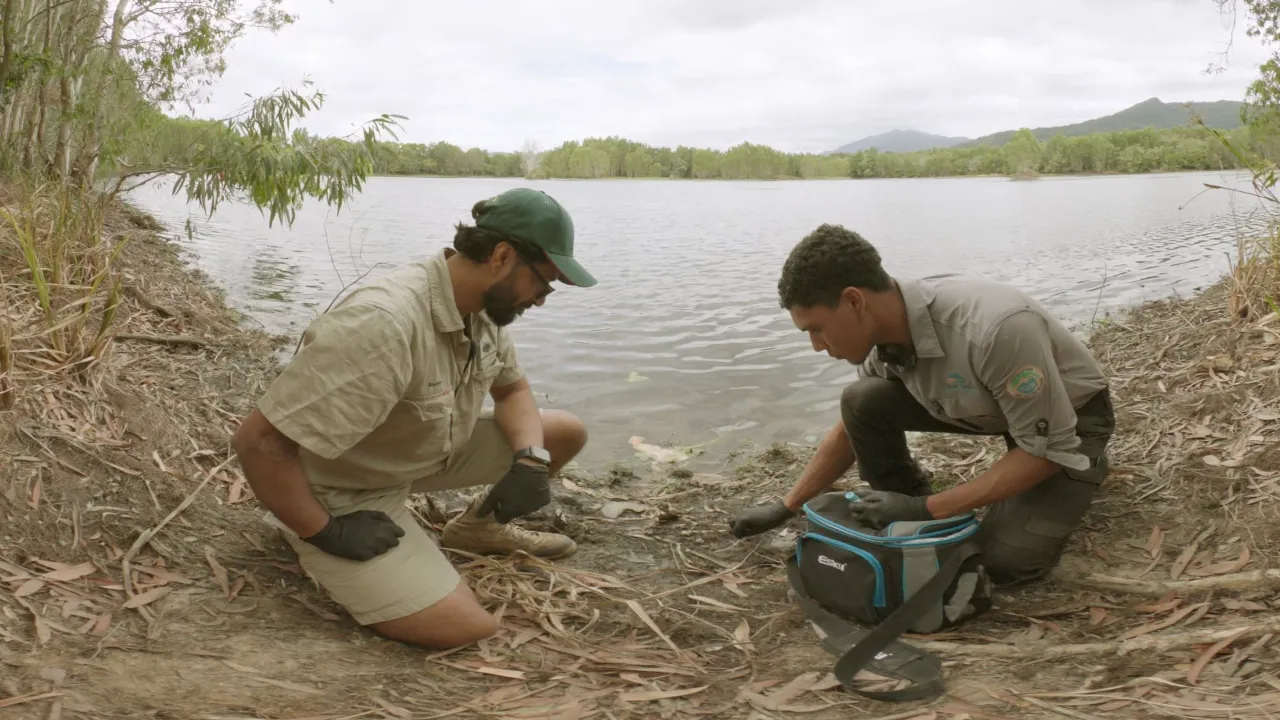
The series covers five areas that rangers encounter in the field: Avian influenza detection by sampling bird poo (while staying safe from saltwater crocs!), marine pest identification, vector mosquito surveillance, plant disease surveillance, and lab practices.
The project was designed as a step up from an earlier commission of five monoscopic 360° videos, with a clear goal: Make the experience more engaging, more interactive, and more memorable.
Mod’s Creative and Technical Director, Michela Ledwidge proposed a structure where each of the five chapters pairs a 5-minute narrative VR video featuring Indigenous rangers demonstrating a procedure on-camera, followed by a 5-minute game, in which players can have a go at the procedure in VR – for example, picking up, examining and sorting specimens, as if they were in the field themselves.

Shooting in Stereo: A Four-Person Crew in Croc Country
Mod designed the live action shoot around what a four-person crew could achieve over six days on location in and around Cairns, Queensland – with locations ranging from inside a biosecurity lab to a swampy lakeshore inhabited by deadly saltwater crocs. The team shot in 3D VR180 using Canon dual fisheye and spatial lenses using both fixed tripod and gimbal rigs, capturing RAW footage for maximum image quality.
The choice of VR180 over full 360° was deliberate: dual fisheye lenses provide an immersive stereoscopic experience with a small on-set footprint, while the forward-facing field of view is ideal for the kind of close-up specimen identification that the training requires. As part of the video shoot, the crew captured 3D scan data of equipment and specimens using handheld and drone cameras – material later processed as photogrammetry and 3D Gaussian Splats.

From Footage to Freeplay: Parallel Pipelines
Post-production spanned two parallel workflows: a DaVinci Resolve project for the 3D VR180 video chapters, and an Unreal Engine game project for the interactive product itself. Over 8TB of shoot data fed both pipelines.
The VR videos were mastered to Apple Vision Pro specifications and then went through extensive optimisation for the lower spec Meta Quest 2 headsets.
Mod’s in-house platform, Rack&Pin was used for production and pipeline management. Grapho, Mod’s knowledge graph toolkit backed by Neo4j, was a critical component of the studio’s production methodology. The project’s knowledge graph modelled everything from script and species data to game logic and narrative design (how interactive story, character, and emotional themes intertwine with game mechanics). This modern knowledge management approach allowed the director to iterate quickly on design, auto-generate visual overviews of the experience, and manage scope and issues as the project evolved.
Custom 10bit video download, playback and caching systems built into the app allowed for effective handling of large video files from Rack&Pin – critical for iterative editorial workflow and the final deployment to remote communities with limited or no internet connectivity.

Testing and Results
Formal playtesting with external testers preceded client testing with five ranger groups. Testers averaged 53 minutes to complete all five chapters, with over 90% completion. Surveys covered playability, video storytelling and stereoscopic 3D comfort – the latter leading to refinements and accessibility features. Players were most engaged with the core mechanic of grabbing and examining diverse specimens, validating Mod’s deliberately simple but tactile game design approach.
The enthusiastically positive feedback from ranger groups confirmed the product’s effectiveness as both a training tool and a community outreach resource, suitable for rangers in training, students at careers expos, and people of all ages.
For producers looking to innovate around existing and emerging creative technologies, Mod’s approach demonstrates that a lean, well-tooled Australian team can deliver production values and interactive depth that punch well above their weight.
Indigenous Rangers VR was shot on the lands of the Gimuy Walubara Yidinji people (Cairns), and the Mandubarra and Mamu peoples (Mourilyan and Etty Bay).