Apex has quickly become one of Netflix’s biggest breakout hits of 2026. Starring Charlize Theron and Taron Egerton, the Australian-shot film debuted at No. 1 globally and remained there for a second consecutive week, surpassing 40 million views by early May.
Directed by Baltasar Kormákur, Apex throws audiences into a relentless survival story set deep within the Australian wilderness. Much of the film was shot across New South Wales, with the Blue Mountains providing the dramatic terrain that defines the film’s visual identity – towering cliff faces, dense bushland, narrow canyons and isolated river systems becoming as integral to the story as the performances themselves.
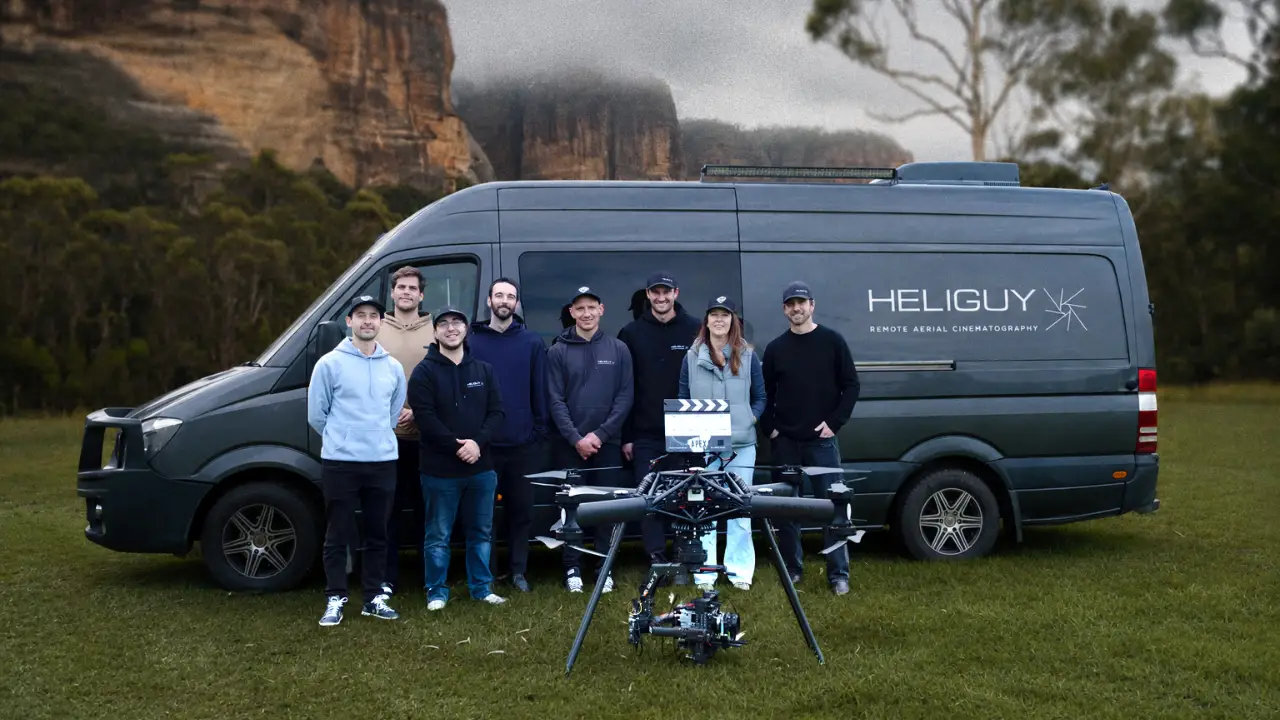
Helping bring those environments to screen was Australian drone and aerial cinematography specialists Heliguy, whose involvement stretched far beyond traditional aerial photography. Across principal photography and VFX capture – including groundbreaking close-proximity cinematography – the company became embedded within the production itself: developing custom drone systems, operating in particularly tough environments and working directly alongside cinematographer Lawrence Sher to help shape the way the film looks and feels.
Using four distinct drone platforms tailored to the production’s demands, the team captured everything from extreme close-ups on primary actors and dynamic movement through difficult terrain, through to multicamera array VFX plates and sweeping establishers showcasing the scale of the Blue Mountains.

Ausfilm spoke with Heliguy Founder & CEO Guy Alexander, Production Manager Kate Ritchie and Senior RPAS Operator Bryan Cheney about operating in extreme environments, custom-building new drone systems, and why the production represents a major evolution in how drones are being integrated into modern filmmaking.
Showcasing the Blue Mountains Like Never Before
For the Heliguy team, one of the most exciting aspects of Apex was the opportunity to shoot in New South Wales.
“This shoot allowed us to show off the Blue Mountains like no other film had done before.”
Guy Alexander, Co-Founder and CEO of Heliguy
That environment quickly became central to the production’s identity. Rather than simply using the Blue Mountains as a backdrop, Kormákur’s approach embedded the audience directly within the landscape itself – often placing the camera in uncharterd territory.

According to Cheney, who served as lead drone operator for all Australian filming on the project, the production’s locations were unlike anything he had previously encountered.
“The Blue Mountains were one of the most memorable locations I have ever shot. That being said, there were a lot of unique challenges,” says Cheney.
The scale and remoteness of those locations demanded enormous physical effort from every department on the production.
“There was a lot of physicality required to operate and navigate in these wildly unfamiliar environments, but this process drew the crew together given we were all confronting similar challenges.”
Bryan Cheney, Lead Drone Operator on Apex
A sequence shot in the ‘Grand Canyon’ of the Blue Mountains comes to mind when Cheney recalls the physically strenuous nature of the shoot.
“You can speak to any of the crew involved in that portion of the film and they will tell you that it was equal parts awesome – particularly what the location was able to offer visually – and equal parts gruelling.”
The conditions frequently forced crews to transport heavy, highly sensitive equipment across steep terrain, waterways and isolated cliff systems.

“The environments that we were capturing had never been shot by a film crew, which meant they were especially difficult to get any kind of infrastructure into.”
Bryan Cheney, Lead Drone Operator on Apex
In an interview with The Cinematography Podcast, Director of Photography Lawrence Sher admits that the physical demands became immediately apparent during the scouting process:
“We must have walked 20,000 steps that day. I wasn’t even thinking about the movie at that point, I was thinking: how am I going to survive this shoot, let alone bring cameras into these environments?”
Lawrence Sher, Director of Photography
Heliguy Production Manager Kate Ritchie recollects some particularly extreme moments:
“There were times that the team had to swim between locations,” she says. “They had to wear wetsuits and helmets – they even had to use kayaks to safely transport equipment.”

“Hulking kilos and kilos of gear for the length of time that he did, Bryan must have lost 15 kilos on this shoot,” Ritchie jokes. “It was demanding, to say the least.”

Despite the difficulties, the team believe the resulting footage justified any hardships.
“The film speaks for itself. To be able to position cameras in those environments for the first time, we were able to give Balt [Baltsar Kormákur] exactly what he was looking for. We came away with some breathtaking shots.”
Bryan Cheney, Lead Drone Operator on Apex
Rethinking How Drones are Used on Set
One of the defining aspects of Apex was the extent to which drone technology became embedded directly into principal photography and became a core storytelling tool.
“As the lead drone operator for all filming within Australia, I was involved in the very early stages of pre-production with cinematographer Lawrence Sher, where we discussed how we would utilise Heliguy’s drone technology,” Cheney explains.
Sher – whose credits include Joker, The Hangover, War Dogs and Garden State – quickly recognised the creative possibilities drones could offer within the confined terrain of the Blue Mountains.
According to Guy, the physical limitations of the locations forced the production to rethink conventional camera workflows.
“The production wasn’t able to use normal crane shots and huge dolly tracks as they usually would, given the physical restrictions imposed by the location – plus, the physical footprint had to be kept to a minimum. It was because of this that Larry (Lawrence Sher) pitched using a small drone.”
Guy Alexander, Co-Founder and CEO of Heliguy
According to Lawrence:
“[The drone] provided a way to get shots we couldn’t otherwise get. It allowed us to navigate tiny little canyons and inaccessible terrain. We could treat it just as we would a crane or a steadicam. I could communicate with [Bryan] in the same way I would with a crane operator.”
Lawrence Sher, Director of Photograpy
The Cinematography Podcast
That shift fundamentally changed the role drones played throughout the production. Guy continues:
“Usually, drones tend to be an afterthought. On Apex, however, rather than just shooting stunt double or wide establishing shots, we were part of the principal photography, working closely with the primary cast.”

“Bryan was in direct communication with the camera operator and [Lawrence], who is one of the best cinematographers in the world,” Guy says. “The ongoing communication allowed them to build a specific visual language with one another. This level of cohesion led to some really beautiful shots.”

According to Guy, the collaboration represented something genuinely new for the industry.
“This is the kind of collaboration that should be celebrated. It’s the kind of collaboration that has rarely been done before – if at all. There are few instances in the world where a drone has been utilised to this extent as part of the principal photography.”
Guy Alexander, Co-Founder and CEO of Heliguy
“A lot of the shots in the film, you could hardly tell were captured by a drone,” Guy says.
Kate Ritchie believes productions like Apex are helping change how the industry perceives drones creatively.
“A film like this only comes along once every so often, where you get to use the drone as something so much more than what people associate the drone with,” she says.
“We never want to take away from the legacy tools that are used on a film set, because they are often the right tool. But in an environment where those conventional methods don’t work, it is a really exciting thing to be able to achieve these things with drone technology.”
Kate Ritchie, Production Manager at Heliguy
Building New Systems for Unfamiliar Terrain
To achieve the film’s more ambitious sequences, Heliguy relied heavily on custom-built drone systems specifically designed for close-proximity filming and harsh environments.
“We are equal parts field operations people and engineers,” Cheney explains. “Working with drones, there is never one build that fits every role.”
Instead, the company continuously designs and adapts systems depending on the technical and environmental challenges of each production.
“Prior to shooting, we deeply consider the locations and technical requirements. Sometimes the right tool for these scenarios doesn’t exist, so we build a solution.”
Bryan Cheney, Lead Drone Operator on Apex
Among the systems deployed on Apex were Heliguy’s newly developed close-proximity drones – lightweight, highly precise aircrafts designed to safely operate near cast and crew within confined spaces.
The systems were also capable of executing repeatable programmed movements for VFX and continuity purposes.

Heliguy’s development work has also coincided with major regulatory progress in Australia. The company recently became the first in the country to secure a CASA exemption allowing heavy-lift drones up to 25kg to operate within close proximity of cast and crew.
“Safety is our number one priority and lies at the core of our designs” Cheney says.
One sequence, in particular, pushed both the operators and technology to their absolute limits.
“The biggest environmental challenge was operating a close proximity drone inside a very narrow slot canyon barely wider than the drone,” Cheney explains. “There’s a high level of experience [at Heliguy]. You need this experience to operate safely and come away with the shots that we did.”

The sequence ultimately became one of the most memorable moments of the production for Cheney and hugely memorable part of the finished film.
“Charlize did a lot of incredible climbing on her own during that particular scene. It was amazing to fit the drone in otherwise unreachable spots to really highlight her climbing ability there.”
A Huge Collaborative Undertaking
As production progressed, Heliguy’s involvement expanded dramatically. Originally expected to work only a limited number of days, the company ultimately remained embedded within the production for more than 50 shooting days – an unusually long run for aerial operations on a feature film.
At times, the company had multiple teams operating simultaneously.
“Three teams were often shooting different locations at the one time: capturing visual effects elements, working with principal photography, plus some live action stunt work with the second unit. It was a huge undertaking,” Guy says.

According to Cheney, the production relied heavily on Heliguy’s ability to operate independently and adapt rapidly. “On big films like this, we send off a second unit or ‘splinter unit’ to capture VFX plates simultaneously with the main shoot.”
“Working autonomously, we were able to move quickly and capture lots of footage without interrupting the larger production timeline.”
Guy Alexander, Co-Founder and CEO of Heliguy
Ritchie says the production frequently expanded Heliguy’s involvement after seeing the material the team was delivering.
“The Line Producer would call me on a Friday evening – realizing how well the team had performed during the week – and ask to have us involved the following week,” she says.
“Because of the relationships that the team established with the wider crew, and because of our ability to pivot where needed and coordinate our operations effectively, it allowed us to be wherever they needed us to be, whenever they needed us to be there.”
Kate Ritchie, Production Manager at Heliguy
Guy praises the team’s ability to accommodate the ever-changing schedule:
“There is a lot of pressure working on an operation of this size… but we delivered.”
Pushing Filmmaking Forward
For the Heliguy team, Apex represents more than just another major production credit, it highlights how rapidly drone cinematography continues to evolve as a filmmaking discipline.
“Drones are at the frontier of filmmaking. They are highly complex and constantly evolving.”
Bryan Cheney, Lead Drone Operator on Apex
That evolution, he believes, is being driven equally by field operators and engineers working together to solve entirely new creative problems.
“These people are super intelligent,” Cheney says of the drone filmmaking community. “They’re massive nerds, in the funniest way.”

Guy hopes productions like Apex encourage more filmmakers to explore more unconventional environments.
“I hope this production can inspire future films or future stories to be told in these sorts of environments that can be hard to get to,” he says.
“You can put [the drones] anywhere, in any space. There’s a lot of freedom there. You can create magic in ways that you never knew you could.”
Bryan Cheney, Lead Drone Operator on Apex
As Apex continues to perform strongly worldwide, the production stands as both a showcase for Australia’s extraordinary landscapes and a powerful example of how local crews, engineering innovation and emerging filmmaking technologies are continuing to reshape the possibilities of modern screen production.