When Sydney’s Flying Bark Productions began developing the visual approach for Stranger Things: Tales From ’85 for Netflix, the challenge was not simply to create an animated series set in the 1980s. It was to understand why the cinema of that era still feels so evocative and then translate that feeling into a contemporary animated production.
The creative language of 1980s suburban fantasy and horror was shaped by more than production design. It lived in the behaviour of film stocks, the imperfections of lenses, the glow of practical light sources, the density of shadows, the way torches bloomed into darkness, and the feeling that something extraordinary could emerge from an otherwise ordinary street, field or forest.
Under the direction of showrunner Eric Robles and executive producers the Duffer Brothers, the goal for the team at Flying Bark was not replication, it was reinterpretation: building an animated world that carried the cinematic DNA of films such as E.T. the Extra-Terrestrial, Poltergeist, The Goonies, Close Encounters of the Third Kind and The Thing, while taking advantage of the intentionality, stylisation and precision possible in modern animation.

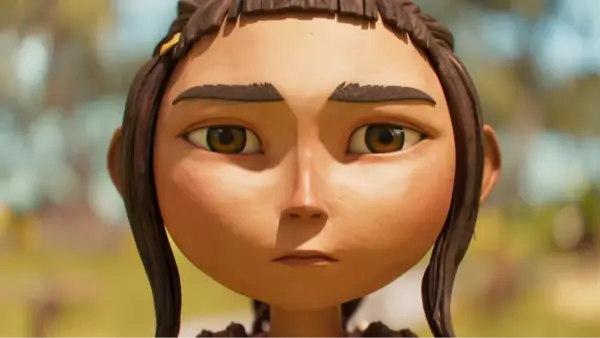
Flying Bark’s visual approach translated the cinematic language of 1980s genre cinema into a contemporary animated world.
“A lot of the early look development was about asking each other what we respond to when we think of 1980s cinema.”
Ben Gunsberger, VFX Supervisor at Flying Bark Productions
Gunsberger continues: “It’s not just the costumes, props or hairstyles. It’s the way highlights bloom, the way practical lights flare, the way film grain sits in the image, and the way shadows still have richness and depth. In animation, none of that happens by accident.”
That became one of the guiding principles of the show’s visual development. Rather than treating nostalgia as a surface filter, the team looked closely at the underlying cinematic grammar of the era. High-resolution scans of 1980s film stocks were examined to understand how they responded to light and colour, particularly the non-linear behaviour of highlights, the density of blacks, and the tactile quality of grain across different tonal ranges.
In live action, these characteristics come from the physical interaction of camera, lens, film stock, lighting and processing. In animation, every one of those qualities has to be designed, tested and integrated into the pipeline. The team studied the structure of grain in those 1980s films and ran multiple tests to develop a synthetic grain treatment that would add texture and atmosphere to the image without creating problems for modern streaming delivery.
“Film grain is emotionally important, but it is also technically complex. If it is too heavy or too random, it can fight the image and create problems downstream. We wanted something that gave the show a tactile, analogue quality, but still behaved predictably in a streaming environment.”
Ben Gunsberger, VFX Supervisor at Flying Bark Productions

Lens behaviour was another key area of exploration. The team referenced the optical qualities associated with 1980s cinematography, including subtle chromatic aberration, vignetting, edge softness, broad blooming around highlights and the particular character of lens-induced flares. These details were not added uniformly. They were treated as part of the visual storytelling system – stronger when they supported mood, atmosphere or supernatural scale, and more restrained when the scene needed intimacy or clarity.
The references spanned a range of 1980s cinematic landmarks. E.T. and Close Encounters of the Third Kind offered a language of wonder and emotional warmth. Poltergeist provided a touchstone for suburban horror and the intrusion of the supernatural into domestic space. The Goonies carried the energy of adventure and discovery. The Thing, while harsher and more adult in tone, offered lessons in atmosphere, body-horror, and the way snow can turn the environment itself into a source of threat.

Practical light sources such as torches, lamps and headlights became central to the show’s visual language.
Torches were a particularly important part of that research. In the Stranger Things universe, torch beams are not just functional props; they are part of the visual mythology of the world. They reveal, conceal, isolate and threaten. To capture the right quality of light dispersion, the team sourced real 1980s torch reflectors and photographed them, using those references to inform how beams spread, broke up and interacted with the atmosphere.
That process helped avoid a common trap in computer graphics (CG) lighting: elements that are technically precise but emotionally sterile. The photographed reflectors gave the team a more authentic pattern of imperfection – the irregularities, hotspots and falloff that audiences associate with real light bouncing off real objects.

“Those little imperfections matter,” says Gunsberger. “A perfectly clean CG torch beam does not feel like the films we were referencing.”
“Using actual period torches gave us a physical basis for the way light should disperse in different situations.”
Ben Gunsberger, VFX Supervisor at Flying Bark Productions
Lens flares received similar attention. The team studied period-appropriate flare references, looking at how spherical and anamorphic lenses each contributed different visual signatures. Horizontal flares, circular artefacts, glare and blooming were all considered, but the challenge was always to keep the work cinematic rather than decorative.

Lens flares and blooming were designed as authored cinematic effects rather than generic post-processing.
This balance between authenticity and authorship ran throughout the production. The show needed to feel connected to the 1980s, but it also needed to function as a modern animated series with its own design language. Too much analogue imperfection could obscure the clarity and appeal of animation; too little could leave the image feeling overly digital. The final look had to sit in the space between those two extremes.
That required close collaboration between departments. Design, layout, surfacing, FX, lighting and compositing all had to contribute to a shared visual language. The ordinary world of Hawkins needed enough realism and texture to make the supernatural feel disruptive, while the heightened sequences needed enough stylisation and control to take advantage of animation’s expressive range.
The result was a production approach where 1980s cinema became less a reference board and more a set of working principles. Practical light should feel motivated. Supernatural events should exist in the environments around them. Flares and bloom should emerge from the scene, not feel pasted on afterwards. Every choice had to support mood, performance and story.

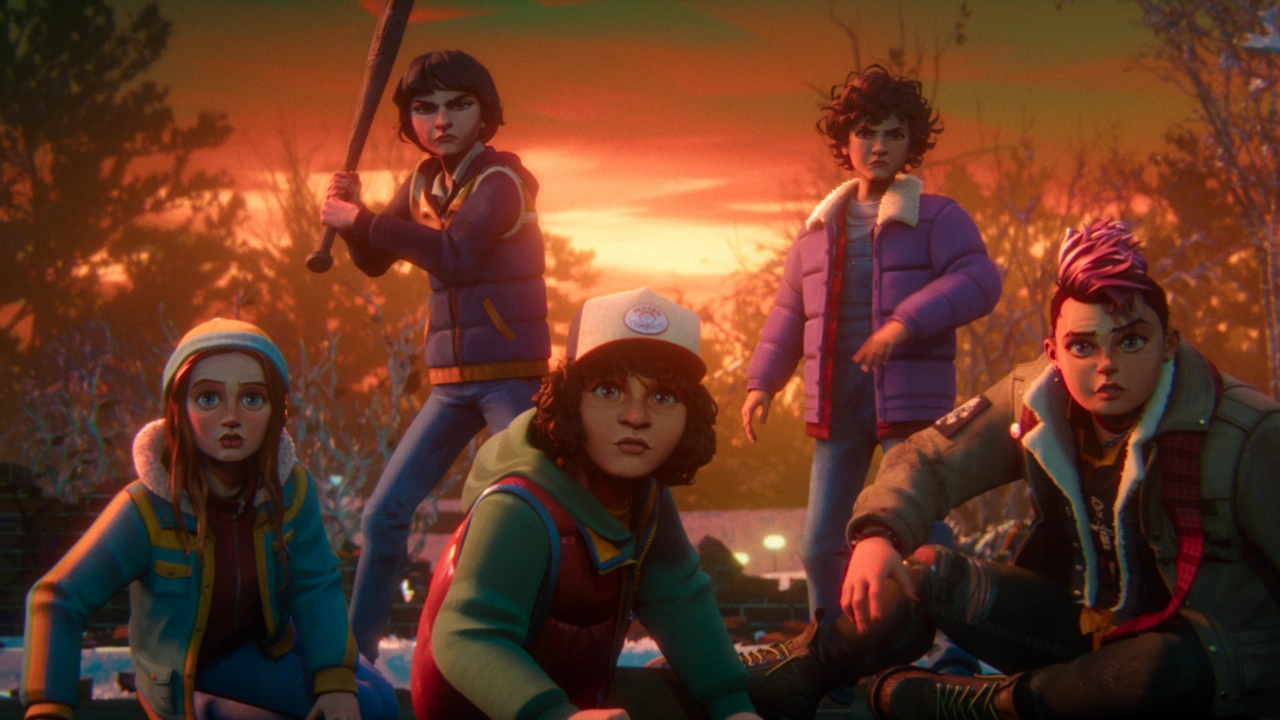
The visual approach balanced supernatural spectacle with quieter character-driven moments.
For Flying Bark, the project represented the kind of high-end animated storytelling that increasingly defines the Australian screen industry: globally recognised IP, complex visual development, advanced production pipelines, and close collaboration across creative, technical and production teams.
The 1980s references gave the team a foundation, but the final image belongs to animation – designed and crafted frame by frame. In that sense, Stranger Things: Tales From ’85 is not simply a return to a familiar era. It is a contemporary reinterpretation of a cinematic language that still has the power to make suburban woods feel mysterious, torches feel heroic, and the darkness beyond the frame feel alive.

The final look reimagines the cinematic texture of 1980s genre films through the precision and control of contemporary animation.
Stranger Things: Tales From ‘85 is available to watch now, exclusively on Netflix.