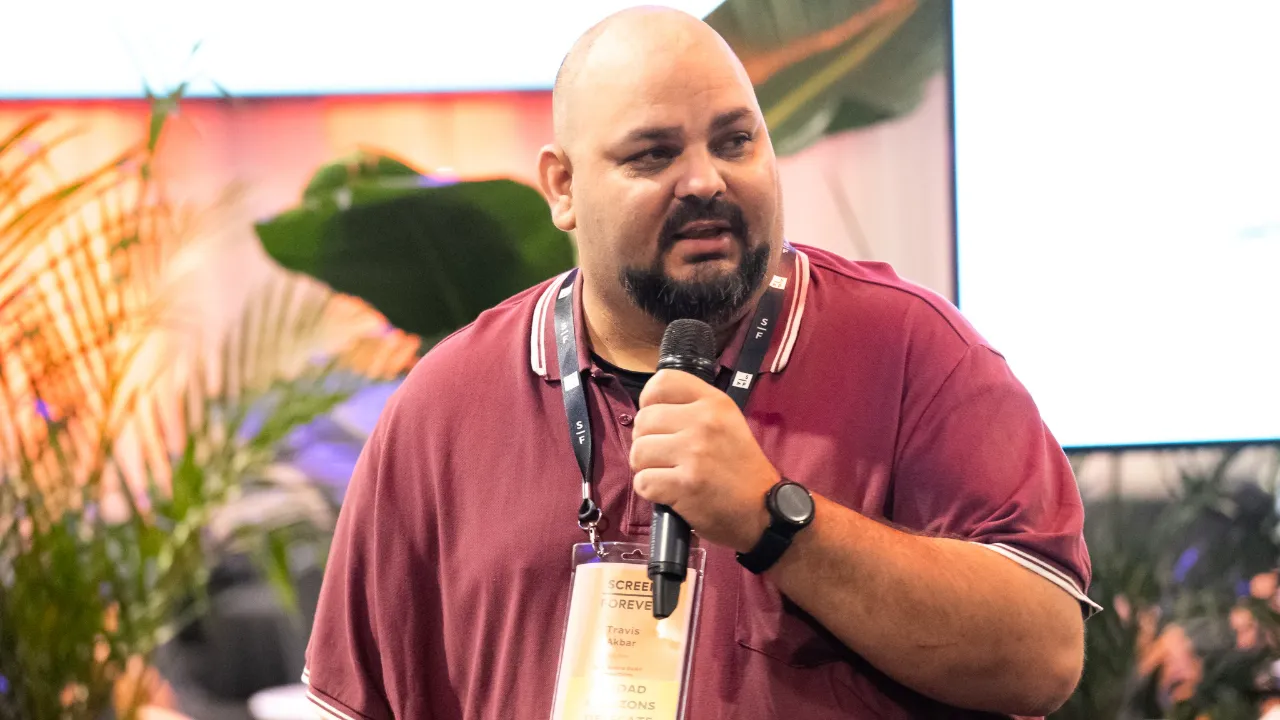
Wongutha filmmaker Travis Akbar has spent the past six years forging a distinct creative path through genre storytelling, industry mentorships, and collaborations with some of Australia’s most respected screen practitioners. But in 2025, he stepped into a new chapter, one driven by a clear gap he could no longer ignore.
Seeing First Nations creatives repeatedly navigating distribution experiences that left them unheard or unsupported, Akbar launched Wirra Distribution, a First Nations-owned company built on transparency, communication and cultural responsibility. Named after the Wongutha word for Coolamon, Wirra reflects Akbar’s vision for a distribution partner that stands alongside filmmakers from the earliest stages, ensuring culturally safe processes and genuine collaboration.
Alongside growing Wirra’s slate, Akbar has also joined the South Australian Film Corporation’s First Nations Advisory Group, where he hopes to help strengthen pathways for key creatives and crew across the state.
We spoke with Travis about the inspiration behind Wirra, his approach to culturally led distribution, and the stories he’s most excited to champion next.

What inspired you to launch Wirra Distribution, and what gap do you see it filling for First Nations storytellers?
When I hear of lacklustre experiences from people, I want to make sure I don’t put others through those experiences, and if I can, help whoever it is that came to me in the first place. Distribution was always a career goal, but when I had heard of, and experienced my own issues dealing with distributors, I decided to make it happen sooner rather than later. As for the gap, we’re always trying to close gaps we didn’t open, in all industries. But if I was to be specific, I just want to be an open, communicative company that can be relied upon for honesty and transparency.
How will Wirra approach culturally safe and culturally-led distribution in practice?
While the productions themselves should be following the right protocols, I want Wirra Distribution to be a trustworthy partner for First Nations, and other diverse practitioners. If we come onto a film earlier, then we can also help ensure that protocols are being followed. The brand will stand by the filmmaker and ensure they are informed of the process, replied to, feel heard etc. Ultimately, Wirra will work with all filmmakers that are allies as well.
What types of stories or filmmakers are you most excited to champion through Wirra in its early slate?
While we have had festival and award success with our first release, SATU – Year of the Rabbit, it is still very early days for the business. There are a number of films we have our eyes on that will be massive for us if we can onboard them, but right now, we are still looking for completed films from diverse filmmakers and allies. I have to say, I have had some really amazing films come my way, but a part of being an honest company means turning away films I can’t afford to distribute in the way they deserve. Hopefully Wirra can get big enough to come on early and support from the outset.

What does your appointment to the SAFC’s First Nations Advisory Group mean to you personally and professionally?
That is a really exciting appointment, the SA film industry has had some rough patches around the successes over the last few years. But there is a lot of change coming up, so I am excited to be driving it, and also an active part of the industry at the same time.
What are the key areas you hope to influence or strengthen for First Nations creatives in South Australia?
Really just supporting First Nations key creatives and crew. There aren’t enough key creatives that have productions coming to fruition and there aren’t enough crew either. In an industry where sustainable jobs are very hard to come by, when your people have been ignored for the better part of the entirety of the industry’s existence in the state, and nationwide, it becomes even harder.
Genre plays a strong role in your work. How do you use action, horror, and tension to explore themes like racism, colonisation and violence?
Yeah, I really like genre. It’s so much fun, but you can still push a message. A lot of people these days think that films are too woke, but the reality is that they just realise it now. Back when I was growing up, genre films were addressing racism, misogyny, sexism, homophobia and more without really making it too on the nose. Even a teen comedy like Varsity Blues covered so many of these issues without it being in your face. With so much knowledge, we can play with it a whole lot more, make it on the nose, hide it, or whatever. It’s a fun time, if you’re not too close minded. While my feature films are slowly taking shape with cast etc, my short films have all explored the themes in the question and still do in different ways. In particular, I like to play off true events and adapt them to what I want to say.
You’ve participated in a wide range of industry programs and mentorships. Which experiences have most shaped your creative practice?
Programs and mentorships are really important. They can be frustrating at times, or repetitive, as everyone is really just trying to keep their heads above water, so things can change at the drop of a coin, but you can really learn a lot. In particular though, the best thing about them, and what has shaped me the most, is meeting the people I want to work with in the future. I have learnt so much off of my fellow creatives.
Your projects often sit at the intersection of entertainment and social commentary. How do you strike that balance?
I believe that film’s number one job is to entertain. It’s an audience driven art-form, and without that audience, there is no art. So, I really try to keep entertainment first, and message second. Some stories call for the message to be on the nose, and others are subtext. But it is also a collaborative art form, so I also believe in listening to feedback, being open to notes and cast/crew suggestions and what not. You still need to stay true to your vision, but being collaborative is just so important. Balancing it all is easy if you are prepared, and understand your story, but if you are not sure on what you are trying to say, it’s bloody hard.
What are you working on right now?
I have some short films in post-production that I have produced, and another on the slate. I am also producing some feature films with my mentor Judd Tilyard, nothing I can mention just yet, and hoping to make my feature directorial debut in 2026. I have some great support around me, luckily.
What is your long-term vision for Wirra Distribution and its role in strengthening First Nations-led storytelling?
I’m taking it slow, it’s early days still, but ultimately, I want Wirra to get to a position where we can help First Nations key creatives from an early development stage. From here, I want to provide a trustworthy and transparent company that is there for the filmmaker, not the dollars. Wirra Distribution isn’t about becoming the biggest distributor in the country, it’s about being reliable.
Learn more about partnering with talented South Australian screen creators like Travis. Contact Leanne Saunders from the South Australian Film Corporation.