For the second season of the hit Apple TV series Monarch: Legacy of Monsters, FIN Design + Effects was tasked with delivering 122 VFX shots across ten episodes, with the heaviest lift concentrated in just three. The project demanded a high level of technical ingenuity, particularly across these key episodes, which required FIN’s most intensive creature work and complex storm simulations to date. It was an ambitious undertaking that saw every department evolve its pipeline to meet the show’s massive scale. From epic storm sequences to intricate creature builds, the project called for new solutions across the board.
The series opens with a cinematic homage to Kong: Skull Island (2017), where helicopters fly through a colossal storm towards an ominous island. FIN’s role was to update and elevate this sequence for contemporary audiences. The team built a large-scale volumetric storm, layering lightning, clouds, and dynamic atmospherics around the island. Thailand location plates were extended with matte-painted environments, while full CG helicopters were created for wide shots. In comp, the focus was on interaction: visor reflections, rotor wash affecting rain and foliage, and contact lighting to ground the sequence in realism.
Monarch: Legacy of Monsters also marked a new milestone for FIN in creature development. As VFX Supervisor Roy Mahli described it: “By far the most impressive creature work we have ever done.”
The Psychovulture, a completely new creature concepted and built by FIN, was among the most technically complex assets undertaken to date. Rigging accounted for muscles, joints, and skin stretch, while groom and texture teams struck a careful balance between insect and reptilian qualities. CharFX simulations ensured the wings flexed and folded naturally in motion.
Another major challenge was the Leafwing, adapted from the original Skull Island comics. Translating this stylised 2D design into a photorealistic CG creature required multiple iterations. Its pterodactyl-style wings and signature electrical effects were reimagined to sit convincingly within a live-action world. As the creature’s look and several story beats evolved after the shoot, close-up moments required CG environment rebuilds – extending plates and adding ferns, dust, atmosphere, and branch simulations to support the creature’s weight and movement.
A standout sequence sees the Psychovulture swoop down to attack the Leafwing. The scene required everything from internal organs and blood simulations to realistic surface textures, ensuring the impact felt visceral without breaking realism. A fully CG tree and surrounding vegetation were built for interaction, allowing the Psychovulture to land, fight, and tear with seamless integration.

Later in the sequence, the Psychovulture lands and devours a larger-than-life Grub. The Grub itself was developed from the inside out by the FIN team – modelling internal anatomy, building deformable muscle and skin rigs, and pairing translucent textures with slime and surface simulations. This foundation allowed extreme close-ups and damage beats to read clearly and credibly, showcasing end-to-end creature craftsmanship that supports the story without drawing attention to itself.
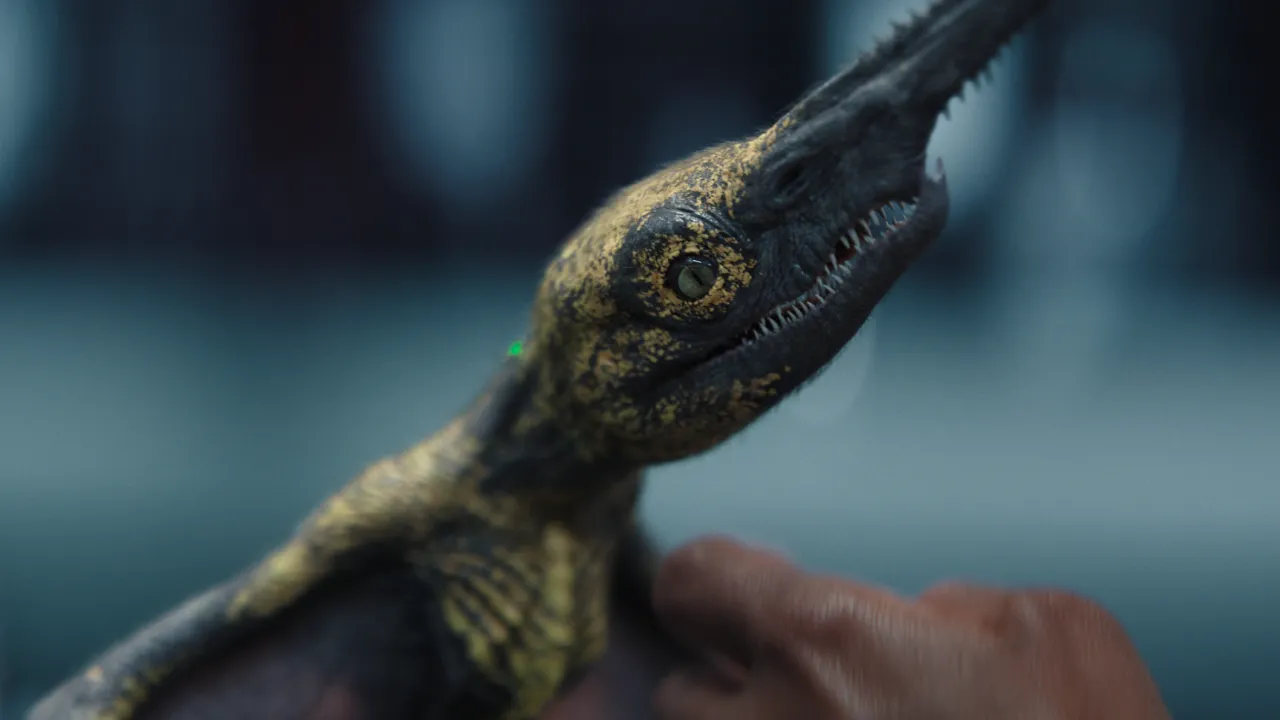
The final result remains faithful to its comic origins while integrating convincingly into the live-action environment. In a laboratory sequence, audiences are introduced to a baby Leafwing, designed to feel like a juvenile creature rather than a scaled-down adult. This required new proportions, subtler rigging, and delicate animation choices to convey vulnerability.

Integration with the live actor proved technically demanding. With no accurate scale reference on set, the FIN team relied on rotomation, matchmove, and shadowing to seamlessly place the baby Leafwing into the plate. Small details – glass smudge passes, consistent arm shadowing, and cloth-like wing motion – helped ground the performance.
While much of the opener relied on full CG, one of the more interesting challenges was restraint. Several shots arrived overly dense with information, prompting the comp team to pull back detail, contrast, and motion to preserve scale, readability, and story intent. The success lay not in sheer resolution, but in thoughtful shot design and cross-department iteration that maintained a cinematic quality.
For FIN, Monarch: Legacy of Monsters represents a significant step forward in creature development. The combination of scale, detail, and realism sets a new benchmark for the studio, with the final result standing as a testament to the team’s technical innovation and creative expertise.