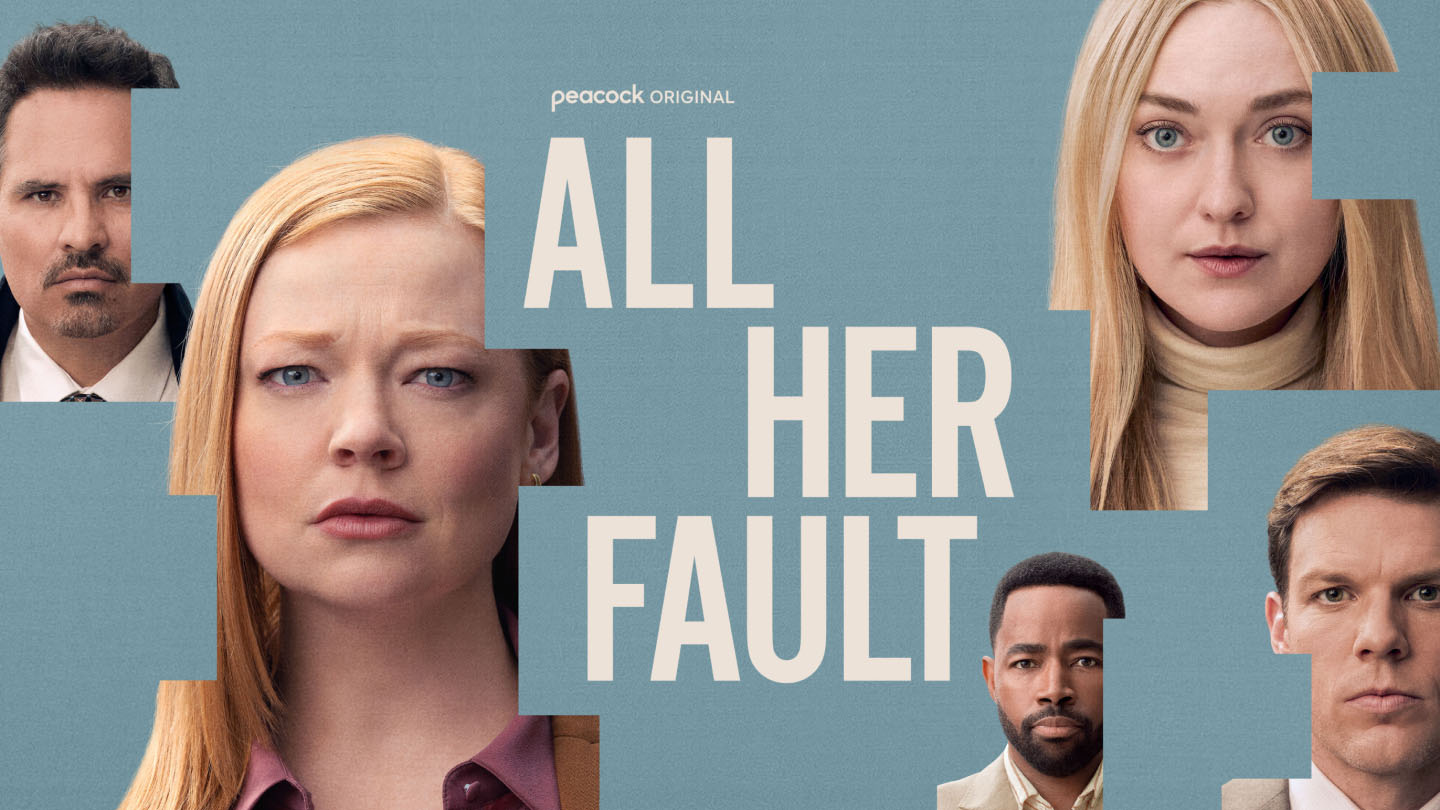
All Her Fault is a dense cinematic series grounded in reality and driven by deeply complex characters. From early conversations about visual effects with director and executive producer Minkie Spiro, it was clear to Blackbird that the series required craft that supported, rather than overshadowed, its character-driven tension.
In this interview, VFX Supervisor Nick Ponzoni breaks down how Blackbird engaged with the show, transporting the audience from a shoot on location in Melbourne, into the streets of downtown and suburban Chicago, taking us through all the puzzle-solving involved in executing seamless, cinematic realism.
How were you involved in the show, and what was your contribution to the VFX?
We joined All Her Fault in pre-production after an early meeting with director and EP Minkie Spiro where we immediately clicked creatively. We were brought onto the show in a hybrid role overseeing studio-side VFX while also serving as the primary vendor. Our involvement spanned the entire project: previz, concept art and on-set supervision, all the way through to final shot execution.
Most of our work was invisible VFX designed to support the character-driven storytelling. Since the series was filmed mainly in Melbourne but set in Chicago, a major focus was on transforming locations, adjusting signage, skylines, foliage, and other details to create a believable Midwestern world.
To support this transition, we built several large digital environments, including the Irvine House and the surrounding Chicago suburbs, and created a complex high-speed car crash which was central to the plot. We also handled a lot of the more mundane touch-ups: screen replacements, paint-outs, window comps and subtle morphs.
How do you approach the role of providing more realistic, invisible fx work?
Our VFX approach leaned heavily into the show’s cinematography and world-building. To convincingly transport viewers to Chicago, we focused on getting the small details right and honouring the composition and lighting of DPs Sergio Delgado and Earle Dresner. Throughout pre-production, the shoot and post, we researched locations extensively and built lookbooks for every scene, supported by reference from teams in the U.S.
This was all done in close collaboration with Minkie, sharing early concepts and refining them into clear plans for how each location would be transformed. Much of the work was strategic puzzle-solving; finding angles where Melbourne could pass for Chicago, deciding what to adjust, and choosing the elements that would add authenticity without unnecessary replacement.
Can you walk us through the process of turning that rural “Irvine House” location into an affluent Chicago suburb?
The Irvine House was a great exercise for us in environmental augmentation. Production found a perfect home for a wealthy Chicago lakeside setting, except it was in regional Victoria, surrounded by gum trees and country roads. To relocate it digitally we built an entire modular CG suburb including houses, streets, vegetation and a full Lake Michigan shoreline complete with simulated waves and silt for some of the big drone shots.
We used a modular, kit-bash approach which let us collaborate closely with Minkie and Sergio to refine the layout. Several sequences had to be tightly choreographed so we previsualised them early. This allowed us to shoot the location with a clear plan and focus our resources on what needed bespoke builds versus what could be reused.
How did that collaboration with the DP and director take shape in practice?
Relationships are built on mutual respect, trust and clear communication, so we invested time in understanding the visual language that Sergio and Minkie wanted, buying into and immersing ourselves in their goals. An advantage of handling both studio-side VFX oversight and hands-on shot work is that communication becomes very direct. Feedback from Minkie, Nigel (Marchant), Joanna (Strevens), Christine (Sacani) or Megan (Gallagher) went straight into the hands of the artists. That streamlined process removed red tape and allowed more iterations which ultimately let us push the work to a higher level of polish.
Were there any surprising details that made a big difference in selling the illusion of a Chicago?
What was surprising is how much of the illusion depended on such small details. While the Chicago skyline was important, once you’re on street level what really stands out are the small details like speed-limit signs in kilometres instead of miles, subtle Australian branding, traffic moving in the wrong direction, and the trees. Even road surfaces, footpath widths, and background traffic patterns needed attention.
An underplayed part of the transformation work was just in deciding with the producers and directors which details were truly immersion-breaking versus those which weren’t. Then you find the most efficient fix which could be flopping a shot, removing an element or adding a bit of CG. That sort of collaborative problem-solving is really rewarding because it lets us achieve more with less. It feels like a real contribution.
The car crash and drone shots over the lake were done heavily with CG, can you walk us through that process?
The car crash was originally planned to be substantially practical, which we fully supported as in general we push to have get as much in-camera as possible. Unfortunately, due to permit limitations and shoot restrictions, those plans had to eventually change and so the sequence shifted to a full CG crash.
With that said we still tried to ground everything in reality; interiors were filmed on an LED volume using environments rendered by Nant Studios, and the post-crash vehicles and the location were scanned by Myriad Studios and rebuilt in CG as exact matches.
After the post-crash scene was shot with practical car wrecks, we worked with Nant, DP Earle Dresner and director Kate Dennis to rebuild the crash so that the end-state would feel like a natural outcome of the way the cars collided. We then “uncrashed” the vehicles in CG, adjusting post-viz so the right parts of the car were damaged during the impact to match all the little bits of practically scattered debris and destruction provided by Production designer Rob Harris. Ultimately, it was a huge puzzle, timing, physics, choreography, followed by meticulous simulation and endless polishing.
For the drone shots over the lake and Irvine House, the process was more about preparation. We gathered extensive aerial reference from Chicago of skylines, suburbs and shoreline footage, which informed the environments. The aim was to create digital locations that could plausibly exist anywhere along Lake Michigan, then apply that knowledge back to plates shot in rural Victoria and outer Melbourne.
Once the house and its surrounding suburbs were fully built in CG, we could deploy them across many shots. We essentially constructed a reusable digital world, enabling quality at scale and helping manage a high shot count within budget and schedule. Efficient backend workflows let us roll that world out across sequences and episodes with consistency and speed.
Is there a shot or sequence you’re especially proud of because it exemplifies invisible VFX done right?
The first establishing shot of the Irvine House was a favourite. It begins with a wide drone move over simulated lake, travels along the digitally extended shoreline and up the garden, revealing a full CG suburb, before dropping seamlessly into a Steadicam follow. The work from XM2 was incredible here as well as scanning the environment, they did a seamless take over from the aerial drone shot to handle held, the whole shot is elegant and underscores the contrast between the characters’ privilege and the story’s mounting dread.
Another standout was a shot that starts on a car in a Melbourne parking lot, cranes up into a high drone, and then tilts to reveal the Chicago skyline. To make the transition seamless, we scanned and rebuilt the school and hero vehicle, matched Melbourne and Chicago geography, created detailed pre- and post-viz, handled complex lens math and film-back changes, and combined a mix of scans, photogrammetry and bespoke builds. In the end, the only note was that one of our trees looked a bit too autumnal.
It’s the kind of work where viewers will never know how many people, across three continents, contributed to a single shot. And that’s exactly how we like it. Our goal isn’t just to create impressive VFX but to guide the audience naturally into this imagined world. A series like All Her Fault is built on close collaboration and shared vision, it’s only from that foundation you can execute the work with real passion and finesse.